Wednesday, March 12, 2014

Games for language teaching and learning


www.speakinglish.com


Following on from Jyh’s post about the play museum, I thought I’d write about how we can use games in language teaching and learning. 


As a language teacher in Portugal in the 1990s, there were lots of games I used with my students. One favourite was the grammar auction, where students had an amount of (imaginary!) money and had to bid for sentences. If the sentence was correct, they doubled their money; if it was ungrammatical, they lost their money. Fortunes were made and lost in the space of a lesson! 

Another favourite activity was picture pairs, where cards represented pairs of words and pictures. For example, a picture of an umbrella was matched by the word ‘umbrella’ on another card. All the cards started off face down, and students could turn over two cards at a time in order to find a perfect pair. These cards could be difficult for the artistically challenged teacher to make, but fortunately there were several good books of grammar games with photocopiable activities. Two very useful  books were Penny Ur’s Grammar Practice Activities and Mario Rinvolucri’s Grammar Games. There were others whose names I’ve forgotten, but perhaps you’d like to share your ideas in the comments box below?
www.gamecarpets.com

Another game was snakes and ladders, in which students threw a dice to go round a board and answer questions on aspects of English grammar. If they answered wrongly when their counter was on the head of a snake, down they went to the snake’s tail a few rows below. However, if they answered correctly at the foot of a ladder, they could go a long way up the board.


We also played dominoes, with words and definitions, or pictures and written words, on different domino rectangles. And of course, we played a lot of bingo, with numbers and words. A
photo by Julia Miller
slightly less lugubrious variation on the word game hangman was the spelling shark, in which students had a limited number of opportunities to guess the letters that made up a word. If they weren’t quick enough, and didn’t guess the word in number of chances available, the stick figure on the whiteboard walked off a cliff and fell into the mouth of a hungry shark.  The number of chances increased if the teacher was feeling generous!


photo by Julia Miller
With very young students, musical colours was a winner. The children danced around to an English song, and when the music stopped they had to stand on a large piece of paper in the colour called out by the teacher. We also did this activity with shapes.


Many games were enjoyed by students of all ages. However, some adult learners and parents of younger students worried that games were not a ‘serious’ learning activity. Their fears were unfounded, as students in my classes were motivated by the games and did well in exams. 

Although, as a teacher, I spent a lot of time preparing materials, these games could be used again and again, and brought a lot of pleasure to my students, while at the same time stimulating them in their language learning. Nowadays, of course, there are so many opportunities for online language games too. What are some of the language learning games and websites that you like best?

Saturday, March 1, 2014

Playing in Singapore

Currently, there is a worldwide movement acknowledging the importance of play in the development of children. Playeum, or The Play Museum places several play stations in an enclosure emulating the concept of museum without walls. The aim is to provide multi-disciplinary cultural experiences for families and such a concept is well-received because Playeum has found its sponsorship in major cities.

                                  Parents and children collaborating at the pictorial wall

According to the organizer's flyer, Playeum has found its way to Melbourne through ArtPlay Arts Grant in 2011, won a Traiblazer Award presented at the British Museum, London, in 2010, and earned a Whitmore Drawing Inspiration Award, London, in 2009. In Singapore, Playeum became a reality at Tampines Central Community Complex, on 23 February 2014. It was a well-organized event attended by many parents and close-knit family members along with young children.
                                  Playeum at Tampines Central Community Complex Feb. 2014

There are many play stations set up for children to create, innovate, shape and design with confidence. Some of the playful activities included drawing on a large pictorial wall, using flour to mold various shapes with plastic casts, assembling hand-made designs on cards as part of the creative display for the wall mounted on the stage, and running through a maze of cloths to draw on the paper found in selected panels.

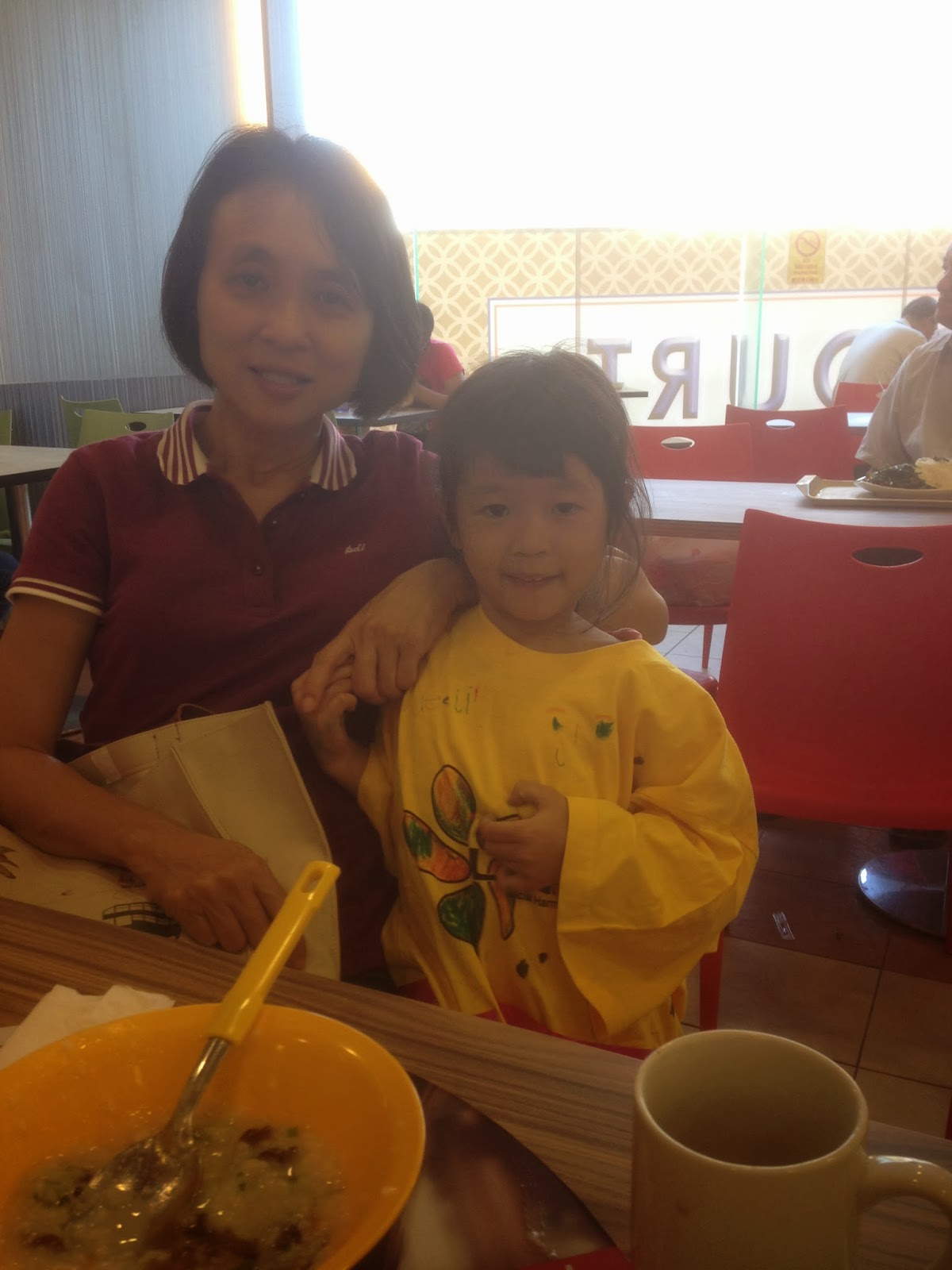
Designing on a T-Shirt is another interesting play form that offers much scope for creativity. Young children were captivated by the task. Some put their hard work to practical use by wearing the shirt immediately after they had put their heart and sweat into the designs.
                                          Molding with flour was a captivating activity at Playeum
The Guest-of-Honor, Mr. Heng Swee Keat, Minister of Education in Singapore, was present at the Community Centre. In his speech, he informed parents that unstructured play is an important part of a child’s life. At present, schools in Singapore are also putting emphasis on the EAGLES Award that speaks of students' leadership achievements as an integral part of holistic education. EAGLES stand for Edusave Award for Achievement, Good Leadership and Service which is awarded to Singapore students based on their co-curricular activities and contribution to community services over a one-year period.

At the Community Complex, many parents picked up useful tips from experts who shared some of their observations from studying children at play. One panelist shared her findings that all children wanted to be with their parents as indicated in their narratives for the pictures they drew, which always contain a participating parent event though the parents were not made visible in the picture. Another expert noticed that a child might develop a routinized feeling towards extracurricular classes  that they are enrolled in if they are not provided with their own play time. Going to a music lesson, for example, is not the same as playing the instrument on their own and recognizing their particular strength in the musical genre.
                                          A sense of satisfaction: wearing a self-designed T-shirt

More importantly, an expert also informed that pre-school children lacking drawing ability may indicate a lack of confidence due to the fear of drawing something incorrectly. The resolution is simply to encourage the child to draw openly according to her own view. Confidence would eventually develop from the drawing task. Another expert reminded parents that it is acceptable to have play-talk with young children as a form of bonding. Conversation need not always be a question-answer formulaic sequence. Questions may lead to more questions as a form of interactivity between parents and children.

The message is clear from Playeum that as part of a normal childhood, children must be given the space to explore with colors, glue, flour, paper, ribbon, cloth, straws, etc., not least because such behavior might not be readily available nor would it be a welcome way for some children to spend time at home. The organizers might have generated the realization that it is alright for children to make a mess during play and have fun through the experience even though there is no practical outcome simply because such activities are part and parcel of the personal development in childhood.
I still remember how American television programs such as Sesame Street and The Electric Company enhanced my own command of alphabetical compositions and counting in English. Puppet characters like the Count, Cookie Monster, Ernie and Big Bird successfully reinforced my English counting and spelling that I painstakingly learned in primary school with plenty of fun via rhythmic beats and melodious tunes.

Playeum reminds me that, despite a nightmarish experience in primary school, my language development was rescued by means of playful methodology such as mimicking a cartoon's words, or aping the puppet characters' pronunciation through pseudo-personification. The joy of watching and listening to English on television was all the more important because English as a subject was only spoken occasionally during contact time for a total of 4-5 hours a week many decades ago. One might recall the mimicking effort of a three year-old girl learning to sing in formal Mandarin phrases while dancing in front of the television according to the Chinese music video (Sew, 2013). 

Readers of this blog entry are welcome to share their experiences of playing or playful activities that have contributed to their language or personal development.


Further references

Playeum http://playeum.wordpress.com/

Sew, Jyh Wee. (2013). Sing to read. Grammar Gang. http://thegrammargang.blogspot.sg/2013/08/sing-to-read.html


Jyh Wee Sew
Centre for Language Studies
Faculty of Arts & Social Sciences
Kent Ridge Campus, National University of Singapore

Tuesday, February 18, 2014

Immediately on Top

Year 2014 is the year of the horse in the Chinese Zodiac. One word that revolves around the concept of horse in Chinese, English and Malay is horsepower. As a specific value, horsepower is a common unit of measurement for mechanical power. The horse notion is iconically prevalent in horsepower in some other languages, such as /马力; mǎ (horse) lì (power)/ in Mandarin, or /kuasa [power] kuda [horse]/ in Malay. A short discussion on iconicity is available in Sew (2005).
                                     image taken from http://thedesigninspiration.com/photos/horsepower/

Cataloging lexical compounds between Chinese, English and Malay for a contrast of morphosyntactic variation makes a typical comparison. The morpheme horse is at the initial position of the English and Chinese lexical composition in contrast to the final position of the Malay compound. In terms of lexical combination, the Malay bipartite compound kuasa kuda  exists in an opposite combinatory to horsepower and /马力/ in Mandarin. 

In the remainderof this blog post, the focus is on the Chinese characters horse and top. /马 mǎ 上 shàng/, which initially denote on top of a running horse, is currently an adverb meaning immediately. Jim Gibney (2011), who teaches English in China, observes that /mashang/, which literally means 'at horse speed', turns out to be 'eventually' when it comes to getting repair work done for his building.

In the visual representation below, the idiomatic /mashang/ combines with two other Chinese characters have 有 and presents 礼 to denote a wish that is synonymous to receive gift immediately. From a semiotic viewpoint, the visual representation depicts a gift (written with the character 福 fortune) sitting on top of equine as the main component of /mashang/. If iconic symbolization may be part of cultural semiotics (Sew, 2005), the red paper cutting represents an original aspect of /mashang/.

In Chinese culture, apart from material objects, gift as a cultural concept may refer to the money offered to the host of a wedding or birthday banquet (see the Mandarin skit illustrating the plight of a married Chinese couple who hatched a plan for throwing a 10th anniversary wedding banquet as a strategy to make some quick money in Chun Wan 2014, http://www.chun-wan.com/). Receiving gifts is a double-edged sword, as it may be interpreted as bribery, although it is a cultural practice in many parts of the Chinese-speaking world for establishing guang 关 shi系 (relationship), or networking in a cultural-specific corporate world. The delivery of hampers among business associates normally peaks during the month before Chinese New Year in Singapore and Malaysia.

                                      Image taken from http://www.fudan.org.cn/archives/20119/mashang

Interestingly, there is a reversal of meaning change in the pragmatics of /mashang/. Diachronically, the horse character /马/ and top character /上/ undergo the process of semantic bleaching becoming less equine- and top-like in /马上/. Semantic bleaching is related to grammaticalization - a process in which a lexical word loses its original meaning in time. In terms of diachronic grammar, many claim that grammaticalization is unilateral, i.e. a one way development in which a full lexical word becomes more grammatical gradually. There are others who do not subscribe to the unilateral direction of grammaticalization. This post merely recounts a usage-based situation in which a grammaticalized word regains its original lexical meaning.
For illustration and comparison of Chinese wishes in the real world  that begin with /mashang/, Table 1 contains two types of wish shared verbally during Chinese New Year in Southeast Asia, particularly Singapore and Malaysia. The first type is the immediately-have-thing wish such as immediately own money, house, and car. The second category, in contrast, is the immediately-be-in-a-state wish including immediately be prosperous, immediately be lucky, and immediately be happy.

Mandarin wishes
Hanyu Pinyin
Meaning
ma shang you qian 
(Tho, 2014)
Get rich immediately (Tho, 2014)
ma shang you fang
(Tho, 2014)
Own a house immediately
(Tho, 2014)
ma shang you che [hao] (Tho, 2014, brackets mine)
Obtain a car [licence plate] immediately (Tho, 2014, brackets mine)
ma shang fā cái
Strike a fortune immediately
ma shang hǎo yùn
Become lucky immediately
ma shang xin fú
Blessed with happiness immediately

Table 1: Select Chinese New Year Greetings in Mandarin

The year 2014 offers an immediate opportunity for the horse and top characters to spring into life, as it were, via a zodiac-based fortification in the semantics of wishing repertoire invoked as a face-to-face cultural practice. Both characters /mashang/ reverberate an on-top-of-the-horse meaning because the immediately-wishes in Table 1 are not commonly shared with each other in Chinese New Year yet become relevant and popular in conjunction with the ushering in of the year of the horse.

After knowing that /mashang/ is used to wish for something immediately, or get into a wonderful state immediately, we may append many things or states that are desirable for listeners in our verbal interaction. A well-tailored wish in the year of the horse will definitely enhance one's CQ (cultural intelligence) immediately, so to speak. The scope that follows the immediately-wish is definitely diverse ranging from good health, youthfulness, longevity, pregnancy, daughter, son, or promotion for everybody in accordance to one's preference(s).


Data base and work consulted
Gibney, Jim. (2011). What ma shang really means. Chinadaily.com.cn  http://www.chinadaily.com.cn/china/mychinastory/2011-12/26/content_14327802.htm
Sew, Jyh Wee. (2005). Iconicity. In P. Strazny (ed.). The Encyclopedia of Linguistics (pp. 487-488). New York: Routledge.
__________. (2014). Spring in other dialect. Grammar Gang. http://thegrammargang.blogspot.sg/2014/01/spring-in-other-dialect.html
Tho, Sin Yi (2014). Cheeky equine greetings of the Horse 2014. Rightways: Sowing the seeds to success. http://rightwayssuccess.blogspot.sg/2014/01/cheeky-equine-greetings-of-horse-2014.html


Jyh Wee Sew
Centre for Language Studies, Faculty of Arts & Social Sciences
Kent Ridge Campus, National University of Singapore


Sunday, February 9, 2014

A flying start to university - language know how


Starting university (and even returning to university) is a time of great celebration.   There are many new things to explore and learn as you enter this new phase of your life.

In South Australia, new students will shortly start their orientation to university, ahead of the first week of the semester (in March).

There will be much to learn including where to get the best food on campus; how to buy books; who are the key people in your program of study.

There will also be new ways of doing which can take a while to learn.    As I reflect on my own journey as an undergraduate and postgraduate student, I remember it took me lots of twists and turns before things fell into place with regard to understanding the types of assignments and the style of language required.

By the time I became a Learning Advisor who worked in our Language and Learning services area, I was aware there were some language fundamentals to grasp in order to become successful at uni.   I would like to share these with you.

Firstly, be aware of the different types or genres of writing required.   The free-flowing form of essay writing, with its arguments and justifications, is quite different to the highly objective tone of a report - with its headings and numbered sections and sub sections.  

Secondly, no matter what the genre, structure is also an important part of making yourself understood; ordering your points of difference and giving credibility to your work.   A well structured piece - whether within the whole assignment; at the paragraph or sentence level - is a key way to earn marks.   Linking words - simple or complex - can aid this process.

Thirdly, the tone of writing also plays an important role.   Where an informal tone and use of the first person 'I' might be appropriate for a reflective writing piece, a technical report will let the data speak and create more distance between the reader and the author.   An essay - which may have strong points of justification - will sit somewhere between the two.    Mostly, the tone of your work at university will require objectivity.

Finally, we end with where we really ought to start.   Whenever you approach an assessment piece at university, seek help.  Clarify any points with your lecturer and - if you are able - take your early pieces of writing to your student support unit (they are called various things in different universities).  

We wish you all the best for a flying start at university OR a successful new year.

Andrea and the Grammar Gang


Saturday, February 1, 2014

Going bananas

Let’s talk about the fruits used in the idioms of daily life. Many terms from the fruit category are invoked for describing human beings or human behaviors. For example, it may be good at first for a worker to be the apple of the boss’ eye because it means that the person has become a favorite of his superior. In a different scenario, however, a worker who is genuinely capable at work and received promotion based on merit might be accused of being the apple of the boss’ eye due to the tall poppy syndrome. This is a social phenomenon whereby the talented ones are often resented and criticized for standing out in the crowd due to peer-group jealousy.


Whether it is the apple in sight, or the upper poppy, a person may enjoy a smoother path at work although he or she may be the fruit of envy among the colleagues. I would call the associated jealous crowd green tomatoes, based on the name of a tomato species called Green Envy. The green tomatoes would more likely to consider the successful peers as the bad apples. It is hence twice as hard for the so-called bad apples to maintain a cherry condition with their colleagues, especially if they are in the top banana positions. For one reason, the second bananas or subordinates may have the tendency to turn into sour grapes.
              Green Envy (image taken from http://www.mporchards.com/index.php/about-us/tomatoes)

In Malay, we use sweet corn to describe a person's attributes. A person is inexperienced if he practices a particular trade for setahun jagung [planting sweet corn for a year]. If a person is a green horn, he may be regarded as seumur jagung [as old as sweet corn], which is about 100 days (cf. Kamus Dewan, 2007). Furthermore, jagung kampung [village sweet corn] is a term invoked for referring to a hillbilly living in seclusion and remaining oblivious to the outside world. While a Malay lady’s beautiful calf may be considered as resembling the bunting padi [a paddy bulge] a woman’s pregnant stomach may be described as resembling the bunting keladi [the bulge of water hyacinth] (keladi in general may also refer to yam or taro; see Sew, 2009 for more examples of Malay idioms containing fruit references).
                                                         Bunting padi (a paddy bulge)
                 Image taken from http://seswap.blogspot.sg/2012/02/betis-bak-bunting-padi.html
In the 1940s, my grand aunt was considered a delicate beauty in her hometown. She was called ong-lai-huey in Hokkien literally meaning the pineapple flower. (Beauty in this context is beyond the standards of the Hollywood circle). The household received fresh seafood delivered by the soldiers during wartime. The fruit idiom was an interesting reference that incurred abundance for the family and sustained personal success in her strides, i.e. generated two marriages, the second after the death of her first husband. Marriage was a strategy to fight off poverty and the hardships of life in the 1940s for very many illiterate Southeast Asian women. Half a century ago, singlehood was a social taboo begetting gossips and hate speeches insinuating that the (female) singles were worthless (see the recent Singapore's Media Corp television drama serial The journey: A vogage). It is still the case today in certain Malay communities (Maznah Mohamad, 2013).

Indeed, life is not a bowl of cherries given the fact that there are always rotten apples and sour grapes in our surrounding. We have to learn how to cherry pick our friends and associates. Hence, it is necessry to act intelligently in different situations as we may have to pass the olive branch in one occasion and be as cool as a cucumber in another. As a rule of thumb, we cannot afford to not know beans about our company, not least the ignorance may be an opportunity for others to upset the apple cart.

References
Kamus Dewan [Malay Dictionary]. (2007). Kuala Lumpur: Dewan Bahasa dan Pustaka.

Maznah Mohamad. (2013). Globalisation and gender dissonance among poor Malays. The 14th Malaysia Singapore Forum, 9-10 Dec. Universiti Malaya, Kuala Lumpur, Malaysia.

Sew, Jyh Wee. (2009). Semiotik persembahan wacana [Semiotics of discourse performing]. Kuala Lumpur: University of Malaya Press.

Jyh Wee Sew
Center For Language Studies
Faculty of Arts & Social Sciences
National University of Singapore


Saturday, January 18, 2014

Spring in other dialect

I must write down this Chinese verbal example that I heard while having breakfast in a market-cum-hawker centre before I forget. The reopening of the market place near my house in Jan. 2014 after it underwent renovation for nine months was a relief, especially for people like me who wanted a fast and nutritious breakfast before going to work. Breakfast is never complete without a glass of hot coffee or hot tea in good old Southeast Asian style.


Hot tea served in the heartland coffee shops in Singapore
The image is taken from http://beverageclub.wordpress.com/

As I was sipping my tea one working morning, I overheard the guy serving me coffee talking about somebody acting in a silly manner by sticking the Mandarin word 春[chūn] meaning /spring/ in English on the back of the wok. As some background information, it is perfectly fine to see this Chinese word stuck on the doors and in selected corners of a Chinese house to symbolise the arrival of spring for ushering in Lunar Chinese New Year. (Spring is a symbolic concept in a tropical country like Singapore) It is a traditional as well as a current practice for invoking the sense of festivity by putting up red strips of spring- and fortune-related Chinese words among many Chinese household in Southeast Asia.

                                                      The Mandarin Character for Spring
                                 The image is taken from http://mydiamondsutra.net/index.php 

According to the coffee seller, however, sticking the Mandarin word /spring/ on the wok at the hawker centre is not a good commercial-cultural strategy, not least the word is also sound symbolic to the word /chuun, tonal marking excluded/, which means /remain/ in Hokkien, another Chinese dialect spoken in Singapore, Malaysia and some parts of Indonesia. Playing by a Hokkien ear to the Mandarin /spring/ in a food business context would simply beget a possible situation whereby the food prepared for sale will remain as leftover in the stall. The three patrons including me had a hearty laugh while eating our breakfast, paying little interest to the validity of the cultural hypothesis, at first.
Instantaneously speaking in Hokkien, one male patron responded in a rather logically manner that it would definitely be the accurate move to stick the word in the kitchen at home, for at least there would be leftover every day. Of course, having leftover is not a good practice in the critical eyes of a nutritionist who would be insisting on all the meals served fresh. However, to a common Chinese mind, (cooked) food available in a kitchen is a sign of abundance and indexical to some form of basic happiness with hunger kept at bay.
While I am not sure if anybody would pay too much attention to the cultural semiotics underpinning the traditional practice of putting up auspicious Chinese words, I bet nobody in a normal mindset would dare to stick an inauspicious phrase or evil-sounding word at home, in the car or one's bedroom. We did have popular rock bands singing out loudly unauspicious words in their songs and in the case of one rock group, the lead singer wound up in a self-inflicted tragic ending.
The moral of the lesson is to offer good words to our loved ones no matter how redundant or insignificant they may seem to be at first. I remember seeing loving words in the Christian households, religious reminders in the Malay households, encouraging words in my hostel mates’ rooms and, of course, wealth-related words in Chinese commercial sites. There must be good reason if not symbolic-semiotic reason to be surrounded with good words in whatever language that speaks to our heart and soul.

Jyh Wee Sew
Centre for Language Studies
Faculty of Arts & Social Sciences
National University of Singapore

Sunday, January 12, 2014

Chinese Lion Twerking

This morning, my brother-in-law, KT, updated his Facebook status with a video clip of a Chinese lion dance. Indeed, it is an apt move in the remaining two and half weeks leading up to Chinese New Year. Upon clicking the video clip, I felt a sense of festivity looking at two Chinese lion masks styled by two youngsters, respectively prancing around in unison mimicking lion-like moves.

Suddenly, to my horror, the drumming and beating of cymbals turned into an upbeat English tune blaring a familiar song I knew from The X-Factor Show. The Chinese lion dance teams suddenly took to the English tune with the dancers swaying into a modern dance performance re-hatching a typical roadshow scene that has become a common sign of out-door jamboree in this part of the world.

While fusion as a means of survival was the only consolation I could think of, I would at least like the modernistic mediation to incorporate an upbeat Chinese pop song by the songstress A-Mei, or the pop band Wu Yue Tian, both of whom are Taiwan-based Mandarin performers who have a massive following in the Chinese world. The video simply showed an example of global force unpacking a local tradition (although at the back of my mind I heard Walter Mignolo saying….it’s glocalization).
I am not pointing fingers, nor am I taking a purist stand against Chinese lion dance twerking; I myself prefer listening to Rihanna rather than Fish Leong. For me, no Karaoke session is complete these days without Pink’s Just Give Me A Reason with Nate Ruess. But at the same time, I would not stick in English phrases when I sing 当爱以成往事[Dang Ai Yi Chen Wang Si (lit. means when love becomes a thing of the past), the theme song of Farewell to my concubine, for which Leslie Cheung acted in the movie and sung the theme song.
Authenticity becomes all the more important with the threat of globalization or glocalization. We need to safeguard certain qualities in traditions that took decades if not centuries to evolve. Although languages may be an exception to this point, as they thrive with the introduction of calques, coinages, and loans, the transformation is really based on the need for naming rather than a fanciful change of heart (although slang and certain street cultures are counterexamples).
For example, the word /twerking/ is a case in point. It seems to me /twerking/ sounds like a calque of the word /twist/ and /jerk/; although the Oxford Dictionaries' record says it is a twenty-year old American English word that originates in bounce music scene from New Orleans, USA (see the reference below). The point here is that something remains best in its original taste/form, just as we would not change our fish and chips, Chinese chicken rice, Malay satay, chocolate cake, etc. when they have achieved gold standard in our hearts.
Reference
Accessed on 13 Jan. 2014
 
Jyh Wee Sew
Centre for Language Studies
Faculty of Arts & Social Sciences
National University of Singapore